August 22, 2026
Mediation vs Moderation: The Essential Difference Researchers Need
Business Research, Research Methodology, Research Tips, Statistics and Data Analysis
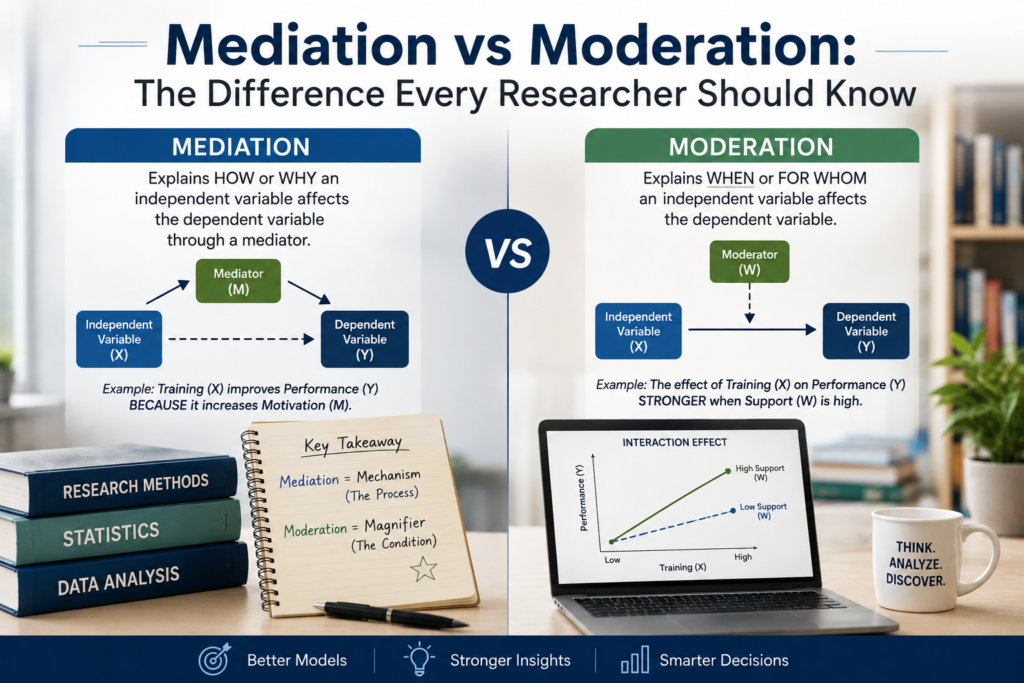
If you’ve sat through a thesis panel defense in the Philippines, you’ve probably heard this question. Is this a mediating variable or a moderating variable?
It’s one of the most common points of confusion we see at StatAce. It’s also one of the fastest ways to lose credibility with a panel if you get it wrong. This guidance is useful for Research for Students, Data Analysis, Statistics for Students, Help for Statistics.
The two concepts sound similar. Both involve a third variable between your main relationship and outcomes, but they answer different questions.
This article breaks down the distinction in plain language, with examples drawn from the kinds of studies we most often see in the Philippine context: education, business, and social science research.
The Core Difference in One Sentence
A mediator explains how or why an independent variable affects a dependent variable. Additionally, a moderator explains when or for whom that effect is stronger, weaker, or reversed.
Put another way: mediation is about mechanism. Moderation is about condition.
Mediation: The “How” Variable
In a mediation model, your independent variable (X) doesn’t just directly cause your dependent variable (Y). Instead, X causes a third variable (M), and M in turn causes Y. The mediator sits on the causal pathway between X and Y.
Example: Suppose you’re studying how transformational leadership (X) affects employee performance (Y). Your theory might be that transformational leadership increases employee motivation (M), and that this increased motivation actually drives better performance. Motivation is the mechanism, the mediator, that explains why leadership style matters.
Visually, a simple mediation model looks like this:
X (Leadership) → M (Motivation) → Y (Performance)
However, if motivation fully explains the relationship, you have full mediation.
Once you account for motivation, leadership style no longer predicts performance on its own.
If motivation only partly explains it, leadership may still have a direct effect on performance.
Even after accounting for motivation, you have partial mediation.
Questions that suggest mediation:
- “Why does X affect Y?”
- “Through what mechanism does this relationship happen?”
- “What is the process that connects these two variables?”
Common statistical approaches: the Baron and Kenny causal steps approach (largely considered outdated but still taught in some programs), Sobel test, and the now-standard bootstrapping approach used in PROCESS macro (Hayes) or structural equation modeling.
Moderation: The “When” or “For Whom” Variable
In a moderation model, a third variable (W, often called a moderator) changes the strength or direction of the relationship between X and Y. The moderator doesn’t sit on the causal pathway. Instead, it interacts with X to influence Y.
Example: Using the same leadership study, suppose you also want to test whether the effect of transformational leadership on performance is stronger for new employees than for tenured employees. Tenure isn’t part of the mechanism connecting leadership to performance; it changes how strong that relationship is depending on who you’re looking at. Tenure is the moderator.
Visually:
        W (Tenure)
            ↓
X (Leadership) → Y (Performance)
Questions that suggest moderation:
- “Does this relationship hold equally for everyone?”
- “Under what conditions is this effect stronger or weaker?”
- “Is there an interaction effect between two predictors?”
Common statistical approaches: moderated regression analysis (testing an interaction term between X and W), or PROCESS macro Model 1 for simple moderation.
A Side-by-Side Comparison
| Mediation | Moderation | |
|---|---|---|
| Core question | Why or how does X affect Y? | When or for whom is the X to Y effect stronger or weaker? |
| Role of third variable | Sits on the causal path between X and Y | Interacts with X, changing the strength of its effect on Y |
| Typical variable type | Often a psychological or process variable (motivation, satisfaction, trust) | Often a demographic, contextual, or trait variable (age, gender, tenure, environment) |
| Statistical signature | Indirect effect (X to M to Y) | Interaction effect (X times W) |
| Common tools | Sobel test, bootstrapping, PROCESS macro, SEM | Moderated regression, PROCESS macro, interaction plots |
Can a Variable Be Both? (Moderated Mediation and Mediated Moderation)
Yes, and this is where a lot of advanced theses run into trouble. Some models combine both:
Moderated mediation happens when the strength of an indirect effect (X through M to Y) depends on a moderator.
For example, the effect of leadership on performance through motivation might only hold for younger employees.
It may be weaker or absent for tenured staff.
Mediated moderation happens when an interaction effect (X times W on Y) is itself explained by a mediator. This is less common in practice and requires a clearly justified theoretical model before you attempt it statistically.
If your conceptual framework proposes either of these combined models, this is a strong signal to plan your analysis (and likely your sample size) with a statistician before data collection, not after.
How to Decide Which One Applies to Your Study
Ask yourself these three questions:
- Does my third variable logically come between my independent and dependent variable in time or causal sequence? If yes, lean toward mediation.
- Does my third variable change how strong the relationship is, rather than explain why it happens? If yes, lean toward moderation.
- Is my third variable a process or psychological state (mediator) or a stable characteristic or context (moderator)? This isn’t a strict rule, but it’s a helpful gut check. Motivation, trust, and satisfaction tend to be mediators. Age, gender, experience level, and organizational size tend to be moderators.
Common Mistakes We See in Thesis Defenses
Calling every third variable a “mediating factor” without testing for mediation statistically. Labeling a variable as a mediator in your conceptual framework doesn’t make it one. You need to run the actual test (indirect effect, bootstrapped confidence intervals) to support the claim.
Confusing a moderator with a second independent variable. If you’re just testing two separate predictors of Y without an interaction term, that’s not moderation; it’s simply multiple regression with two predictors.
Proposing moderated mediation without adequate sample size. These models require more statistical power than simple mediation or moderation alone. A common thesis pitfall is proposing a moderated mediation model with a sample size calculated only for a simple correlation.
Skipping the theoretical justification. Your panel will ask why you believe a variable mediates or moderates the relationship, not just that your software output showed a significant interaction or indirect effect. Statistical significance without a theoretical rationale is a red flag.
The Bottom Line
Mediation explains the mechanism behind a relationship. Moreover, moderation explains the boundary conditions of that relationship.
Getting this distinction right, both in your conceptual framework and your choice of statistical test, signals understanding. This distinction supports Research for Students, Data Analysis, Statistics for Students, Help for Statistics. Practice applying it in your theoretical model to strengthen your analysis.
If you’re not sure whether your third variable is a mediator, a moderator, or both, or you need help setting up the analysis in PROCESS macro, AMOS, or another tool, that’s exactly the kind of question StatAce exists to help with.
Not sure whether your framework calls for mediation, moderation, or a more complex model? Reach out to StatAce, we help Philippine graduate students and researchers design defensible analysis plans before data collection begins.
You might also like

How to Choose the Right Statistical Test for Non-Statisticians
Read more →
Why Reliability Testing Quietly Decides Whether Your Research Can Be Trusted
Read more →
Leave a Reply