June 18, 2026
The Real Challenges of Research Writing: Why Many Students Struggle and How to Overcome Them
Research Advice, Research Conceptualization
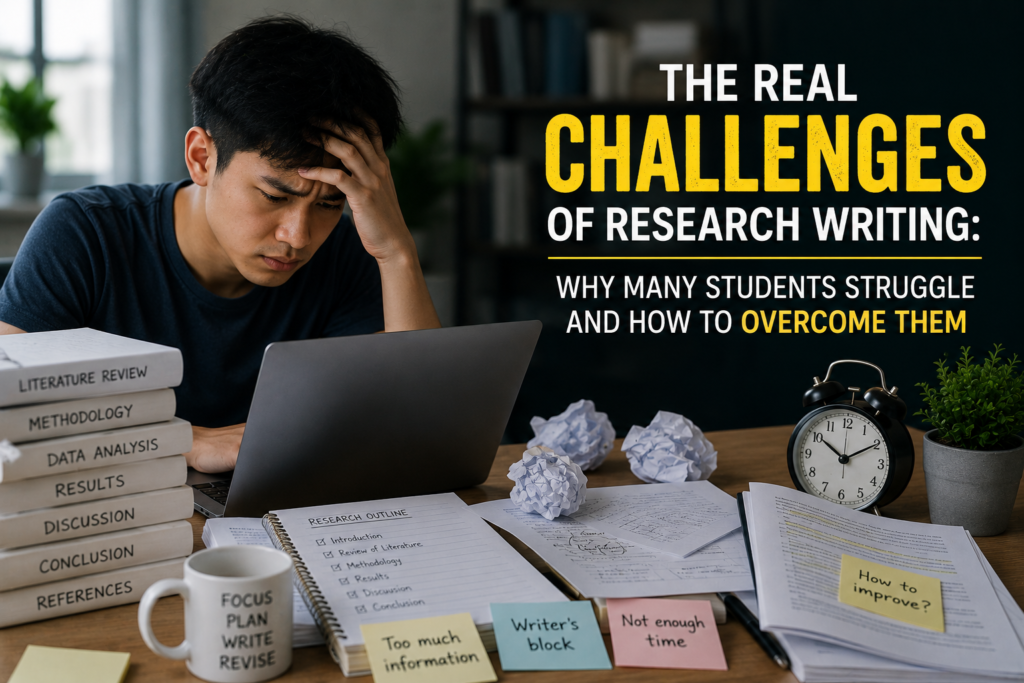
Research writing is often viewed as a simple academic requirement: a paper to submit, a thesis to defend, or a study to complete. However, anyone who has gone through the process knows that research writing is one of the most challenging intellectual tasks a student, researcher, or professional can undertake.
The difficulty begins long before the actual writing starts. Many researchers struggle with identifying a meaningful and researchable topic. While ideas may seem abundant, finding one that is relevant, feasible, and supported by existing literature can be overwhelming.
Another common challenge is reviewing the literature. Researchers are expected to read dozens, sometimes hundreds, of journal articles, books, and reports to establish a solid foundation for their study. Sorting through large volumes of information and identifying what is truly relevant requires time, patience, and critical thinking.
Developing a sound research framework also presents difficulties. Researchers must clearly define their variables, formulate hypotheses or research questions, and establish the relationships they intend to investigate. A poorly constructed framework can affect the entire study and lead to unreliable findings.
Data collection is another hurdle. Whether conducting surveys, interviews, experiments, or observations, researchers often encounter problems such as low response rates, incomplete data, and logistical constraints. Gathering quality data is rarely as straightforward as it appears in research textbooks.
For many students and researchers, statistical analysis is perhaps the most intimidating part of the process. Questions such as “Which statistical test should I use?” or “How do I interpret these results?” are common concerns. The increasing availability of sophisticated analytical techniques such as regression analysis, factor analysis, and Structural Equation Modeling (SEM) has made research more powerful but also more complex.
Even after the analysis is completed, writing the results and discussion sections remains challenging. Researchers must not only present their findings accurately but also explain their significance, connect them to previous studies, and highlight their practical implications.
Beyond the technical aspects, research writing demands persistence and resilience. It requires researchers to accept criticism, revise their work multiple times, and remain committed despite setbacks. Writer’s block, self-doubt, and time constraints are realities that many researchers experience throughout their academic journey.
The good news is that research writing is a skill that can be developed. With proper guidance, structured planning, and the right analytical tools, the process becomes more manageable and rewarding. Every successful research paper, thesis, dissertation, or journal publication begins with a researcher who was once uncertain but willing to learn.
Research is not simply about completing a requirement; it is about discovering knowledge, solving problems, and contributing valuable insights to society. While the journey may be challenging, the impact of quality research makes every effort worthwhile.
At StatAce Research and Statistics Consultancy, we believe that no researcher should face these challenges alone. Whether you need assistance with research design, data analysis, statistical interpretation, or academic writing, our goal is to help transform research challenges into meaningful academic success.
You might also like

How to Choose a Research Topic That Is Relevant and Researchable
Read more →
Why Reliability Testing Quietly Decides Whether Your Research Can Be Trusted
Read more →
Leave a Reply