July 7, 2026
AI Tools and Academic Research: What’s Actually Useful vs. Hype
Academic Writing, Artificial Intelligence
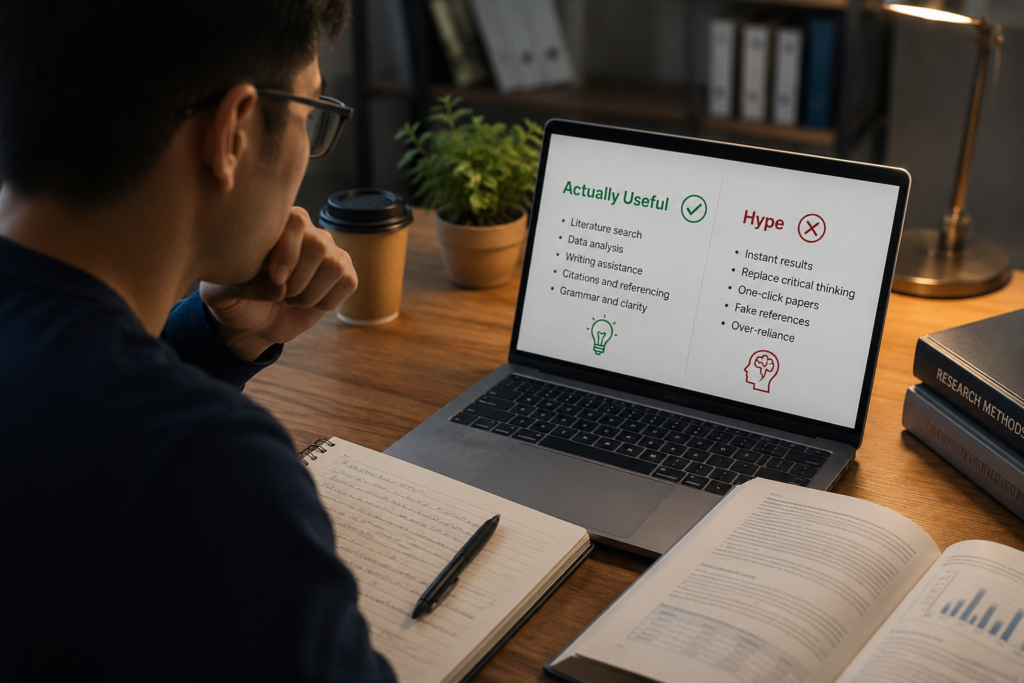
If you’re a graduate student, thesis adviser, or researcher in the Philippines, you’ve probably felt the pressure from both directions this year. On one side, your panel is asking sharper questions about “AI-generated” content. On the other, every research platform now claims to write your literature review, run your analysis, or finish your thesis in one prompt.
At StatAce, we work with researchers every week who are trying to figure out where the line actually is. Which tools genuinely save time and improve rigor, and which ones just create new problems to clean up later, including problems that show up during your oral defense. Here’s our honest take, organized around the actual stages of a research project.
The Hype: What to Be Skeptical Of
“Generate a full paper from one prompt.” Several platforms now market themselves around producing complete, multi-page academic documents, outlines, sections, even citations, from a single prompt. The pitch is speed. The risk is that a paper produced this way often has flawless grammar sitting on top of a misaligned thesis, a weak methodology, or arguments that don’t actually connect. Your panel isn’t grading your grammar. They’re grading whether you understand your own study well enough to defend it, and a tool that writes the whole thing for you quietly takes that understanding away from you.
Citation fabrication. This is the single biggest risk category right now. Tools that generate citations from general training data rather than pulling from an actual paper database can produce references that look plausible but don’t exist, or that misattribute findings to the wrong study. If you’ve ever had a panel member ask you to pull up a cited article and you couldn’t find it, you already know how badly this can go. The safeguard is simple: only trust citations from tools that retrieve them from a real, searchable corpus, and always verify the source yourself before it goes in your reference list.
“AI that understands your data.” Be cautious of tools that promise to interpret your statistical results or write your Discussion section for you. An AI can flag that a correlation exists in your dataset, or that several prior studies share a similar methodological weakness. It cannot tell you why that correlation matters for your field, what it means theoretically, or how it should shape your recommendations. That interpretive work has to come from you, and it’s exactly what your adviser and panel are evaluating.
What’s Actually Useful, Stage by Stage
The researchers who use AI well tend to treat it as a set of specialized tools for specific stages, not one tool that does everything. Here’s roughly how that breaks down:
1. Literature discovery and mapping. This is genuinely one of the strongest current uses of AI in research. Tools built for evidence-backed search can help you find related studies fast, map how papers connect to each other, and build an initial reading list before you dive into full-text reading. Used this way, AI doesn’t replace your literature review. It gives you better raw material to write a stronger one, with clearer framing of your research gap.
2. Organizing evidence, not writing conclusions. Once you have your sources, AI can help build evidence tables that map methods, samples, and findings across studies so you can see patterns at a glance. This is a legitimate time-saver. The moment it becomes risky is when the tool starts drawing the conclusions for you instead of just organizing what you’ve already gathered.
3. Revising, not generating. The safest and arguably most valuable use of AI at the writing stage is evaluation of a draft you’ve already written: checking for gaps in reasoning, inconsistent terminology, unclear topic sentences, or structural issues that could trigger a desk rejection or a rough time at your defense. This preserves your authorship while catching problems a tired set of eyes might miss after your fifth revision.
4. Language polish for non-native English writers. For many Filipino researchers publishing in English-language journals, AI-assisted language checking (grammar, vocabulary, academic tone) is a low-risk, high-value use case. It’s editing your own words, not generating new ones.
5. Qualitative data organization. If your study involves interview transcripts, focus group data, or open-ended survey responses, specialized qualitative analysis software remains the more rigorous choice for coding and thematic analysis compared to general-purpose AI chat tools, which can miss the structured, auditable trail your panel or journal reviewers may want to see.
A Practical Rule of Thumb for Your Thesis
Before using any AI tool on your research, ask:
- Can I trace this back to a real source? If a tool gives you a claim, statistic, or citation, can you click through and verify it yourself? If not, don’t use it as-is.
- Am I using this to organize my thinking, or to replace it? Organizing evidence, checking structure, and polishing language are safe. Generating your Discussion section or your interpretation of results is not, and it will likely show during your defense.
- Have I checked your institution’s policy? CHED and individual universities are still catching up on formal AI-use guidelines for theses and dissertations. When in doubt, disclose your AI use to your adviser rather than guessing at what’s allowed.
- Does this tool handle my data responsibly? If you’re working with sensitive data, such as patient records, unpublished findings, or IRB-covered files, check the tool’s data retention, storage, and model-training policies before uploading anything. This matters doubly under RA 10173 (Data Privacy Act) if your dataset includes personal information from Filipino respondents.
The Bottom Line
AI tools in 2026 are genuinely useful for speeding up the mechanical, organizational parts of research: search, mapping, evidence tables, structural checks, language polish. They are not a substitute for the interpretive and argumentative work that your thesis or dissertation actually exists to demonstrate. The researchers getting the most value right now are the ones using several narrow tools for specific stages of their workflow, verifying everything that comes out, and keeping the thinking, the part your degree is actually certifying, firmly in their own hands.
If you’re not sure whether a specific AI-assisted step is safe for your thesis, or you’d like a second opinion on your data and methodology before your defense, that’s exactly the kind of question StatAce exists to help with.
Have questions about your research design, statistical analysis, or thesis methodology? Reach out to StatAce, we help Philippine graduate students and researchers get their studies defense-ready.

Leave a Reply