June 29, 2026
Why Reliability Testing Quietly Decides Whether Your Research Can Be Trusted
Reliability and Validity, Research Advice, Statistics and Data Analysis

Imagine stepping on your bathroom scale three times in a row and getting 68 kg, then 72 kg, then 70 kg. It’s the same body, the same morning, and only thirty seconds apart. After the third reading, you would stop trusting the scale. More importantly, you certainly wouldn’t use those numbers to make decisions about your health.
That uneasy feeling captures exactly what reliability testing is designed to prevent in research.
Before we ask whether a study has discovered something meaningful, we must first ask a more fundamental question: Can the instrument that produced the data be trusted to measure consistently? If a measurement changes when nothing else has changed, every conclusion built upon it becomes unstable. The statistical analyses, the interpretations, and even the confident claims in the abstract rest on a shaky foundation.
Reliability testing rarely receives much attention in published studies, yet it quietly underpins almost every finding that deserves to be taken seriously. It is one of the most important and most overlooked components of high-quality research.
Reliability Is About Consistency, Not Correctness
One of the most common misconceptions among researchers is confusing reliability with validity. Although closely related, they answer two very different questions. Reliability asks whether a measurement produces consistent results under the same conditions. Validity asks whether the instrument is actually measuring the concept it was designed to measure.
Consider a weighing scale that consistently reads 3 kilograms heavier than your actual weight. Every time you step on it, it gives the same incorrect result. The scale is highly reliable because it is consistent, but it is not valid because it is inaccurate. This distinction matters because reliability is a prerequisite for validity. An instrument cannot accurately measure a concept if it cannot first measure it consistently. While a reliable instrument may still be invalid, an unreliable instrument can never produce findings that inspire confidence.
Simply put, reliability is the foundation upon which validity is built.
What Happens When Reliability Is Ignored?
The consequences of poor reliability are rarely dramatic at first. Your statistical software will still generate tables, p-values, regression coefficients, and significance tests. Everything may appear perfectly acceptable. The problem lies beneath the surface.
When a questionnaire has poor internal consistency, part of the variation in the data reflects measurement error rather than genuine differences among respondents. That hidden error can weaken real relationships, exaggerate weak ones, or even create patterns that do not truly exist.
As a result, researchers may confidently report findings that are influenced more by inconsistent measurement than by actual evidence. The effects extend beyond a single study. When future researchers attempt to replicate or build upon unreliable findings, they inherit the same measurement problems. Over time, unreliable instruments contribute to inconsistent results across studies and hinder scientific progress.
Many of the reproducibility challenges discussed in psychology, medicine, education, and the social sciences stem, at least in part, from inadequate attention to measurement quality. When the ruler itself changes length, it is hardly surprising that researchers disagree about what they have measured.
How Researchers Assess Reliability
Reliability is not measured using a single universal statistic. The appropriate method depends on the type of consistency being evaluated.
Test–Retest Reliability
Test–retest reliability assesses whether an instrument yields consistent results over time. Researchers administer the same questionnaire to the same participants on two separate occasions and compare the scores. This approach is especially appropriate for constructs that are expected to remain relatively stable over short periods, such as personality traits, cognitive abilities, or long-term attitudes. The timing, however, is important. If the interval is too short, participants may simply remember their previous responses. If it is too long, genuine changes in the construct may influence the results.
Inter-Rater Reliability
Whenever human judgment is involved, consistency between evaluators becomes essential. Imagine two teachers grading the same essay or two researchers coding the same interview transcript. If their evaluations differ substantially, the credibility of the measurement is weakened. Measures such as Cohen’s Kappa and the Intraclass Correlation Coefficient (ICC) help determine whether agreement among raters exceeds what would be expected by chance alone.
Internal Consistency
For survey research, internal consistency is the most commonly reported form of reliability. Its purpose is straightforward: to assess whether several questionnaire items measure the same construct. For example, job satisfaction, they should produce responses that are reasonably consistent with one another. The most widely used statistic for this purpose is Cronbach’s Alpha. A low alpha suggests that some items may be measuring different concepts, introducing unnecessary error into the overall scale. Conversely, a higher alpha indicates that the items function together as a coherent measure of the intended construct.
Parallel-Forms Reliability
Sometimes researchers create two equivalent versions of the same assessment, such as different forms of an examination. Parallel-forms reliability evaluates whether both versions measure the construct equally well. If one version is substantially easier or more difficult than the other, scores from the two forms cannot be compared fairly.
Don’t Become Obsessed with a Single Number
Many researchers have heard the familiar guideline that a Cronbach’s Alpha of 0.70 or higher is acceptable. While this rule of thumb is useful, it should never be treated as an absolute standard.
A reliability coefficient is evidence, not a verdict. An extremely high alpha—such as 0.95 or above—may actually indicate that several items are almost identical, repeatedly asking the same question in slightly different ways. In such cases, the instrument may contain unnecessary redundancy rather than capturing the construct’s complexity.
Likewise, a modest alpha may be entirely appropriate for a short questionnaire or for constructs that are naturally broad and multifaceted. Reliability should always be interpreted within the context of the study: the number of items, the nature of the construct, the characteristics of the respondents, and the purpose of the measurement all matter. The goal of reliability testing is not simply to achieve a desirable number. Its real purpose is to understand how much confidence you can place in the data your instrument produces.
Good Reliability Begins Before Data Collection
The best reliability testing starts long before the final dataset is collected. Pilot testing allows researchers to identify confusing wording, ambiguous questions, and poorly performing items while revisions are still possible. It is far easier to improve an instrument before collecting hundreds of responses than after the analysis has already begun.
Researchers should also report the reliability coefficients calculated from their own sample, rather than relying solely on values reported in previous studies. This is an important distinction because reliability is not a permanent characteristic of a questionnaire. Instead, it reflects how consistently that instrument performs within a specific group of respondents under particular conditions. If human raters are involved, they should receive appropriate training, and their level of agreement should be evaluated before formal data collection begins.
Finally, when reliability falls below expectations, researchers should resist the temptation to hide or ignore the results. Acknowledging limitations and explaining how they were addressed demonstrates scientific integrity and ultimately strengthens the credibility of the research.
Final Thoughts
Reliability testing may never be the most exciting part of the research process, but it is undoubtedly one of the most important. Every statistical analysis, every hypothesis test, and every conclusion depends on one fundamental assumption: that the data accurately and consistently represent what they were intended to measure. Before asking whether your findings are statistically significant, innovative, or publication-worthy, ask a simpler question:
Can you trust the instrument that produced them? Because trustworthy research does not begin with sophisticated statistics. It begins with reliable measurement. Everything else depends on it.
You might also like
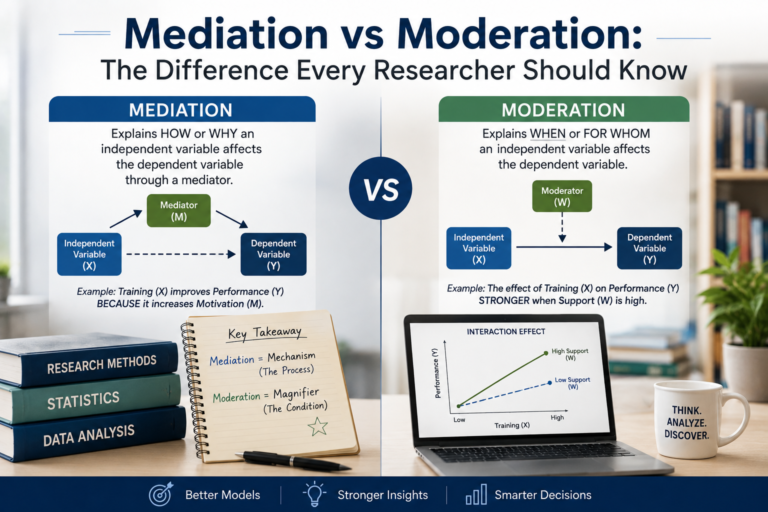
Mediation vs Moderation: The Essential Difference Researchers Need
Read more →
How to Choose the Right Statistical Test for Non-Statisticians
Read more →
Leave a Reply